
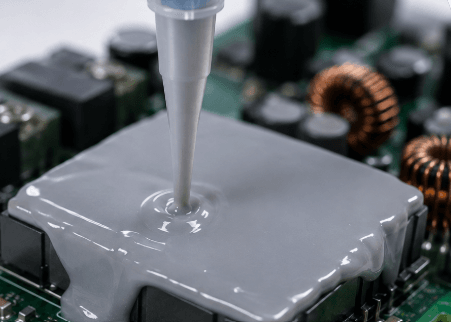
How Silcotech Industry Helped a Power Electronics Manufacturer Eliminate Recurring Field Failures in Potted Assemblies
How Silcotech Industry Helped a Power Electronics Manufacturer Eliminate Recurring Field Failures in Potted Assemblies
Three months before a major product launch, a mid-volume power electronics manufacturer started seeing something they couldn't explain: units that passed every bench test were failing in the field, and the failures all traced back to the same general area of the board — right where the power module sat under a layer of potting compound. The client, a contract manufacturer producing sealed power converters for industrial and off-highway equipment, had been using a general-purpose potting compound for years. It had never been a problem until the newest generation of converters pushed higher current density into a smaller enclosure, and heat that used to dissipate safely now had nowhere to go.
The Challenge
The manufacturer's engineering team had already isolated the failure mode: localized thermal buildup around the power module was degrading solder joints and, in a smaller number of units, causing intermittent shutdowns under sustained load. The existing encapsulant was doing its job as a moisture and vibration barrier, but it wasn't moving heat away from the module fast enough, and it was starting to look like a redesign of the enclosure — a costly, schedule-killing option — might be the only fix.
- Field returns tied to thermal stress were climbing month over month
- The failure only showed up under sustained real-world load, not standard bench qualification testing
- A launch date was fixed, leaving little room for a full mechanical redesign
- Any material change had to preserve the existing dielectric strength and vibration protection the client depended on
- The client's own quality team was under pressure to explain the root cause to their end customer before the next production run
For the client, this wasn't an abstract materials question. Every week spent chasing the wrong fix was a week closer to a launch date they couldn't move, with an end customer already asking pointed questions about reliability.
The Solution
Silcotech's applications engineers started by reviewing the client's thermal model and load profile rather than jumping straight to a product recommendation. The existing potting compound had adequate dielectric and mechanical properties, but its thermal conductivity simply wasn't built for the new power density the client's design called for.
- Thermal path analysis — Silcotech's team mapped where heat was actually concentrating inside the sealed enclosure, confirming the module, not the board layout, was the bottleneck.
- Material substitution, not redesign — Rather than recommend a mechanical change, Silcotech proposed a two-component, unfilled thermally conductive silicone rubber encapsulant with a thermal conductivity of 1.73 W/m-K, a substantial step up from the client's incumbent material, while holding onto the dielectric strength (610 kV/in) and dielectric constant (2.5) the design needed to stay electrically safe.
- Process compatibility check — Because the compound is room-temperature curing, Silcotech confirmed it could drop into the client's existing potting line without new curing ovens or a change to cycle time — a detail that mattered given the launch timeline.
- Sample builds and thermal cycling — Silcotech supplied trial quantities so the client could pot a small batch of units and run them through the same sustained-load conditions that had triggered the original field failures.
- Joint review of results — Engineers from both sides reviewed thermal imaging from the trial units together, comparing hot-spot temperatures against the incumbent material side by side.
Technical Support & Collaboration
What stood out to the client's engineering lead wasn't just that the material worked — it was how the evaluation happened. Instead of routing questions through a sales rep, the client had a direct line to Silcotech's applications engineers from the first call. When trial results came back with a question about viscosity and flow into tight spaces around the module, that question got answered by someone who understood the chemistry, not someone reading from a spec sheet.
The cadence mattered too. With a launch date bearing down, the client didn't have time to wait days for callbacks. Silcotech kept communication tight throughout the trial phase, flagging early what to expect from the compound's handling characteristics — including its viscosity — before the client hit any surprises on the production floor. That kind of transparency meant the client's team could plan their own qualification schedule with confidence instead of building in slack for the unknown.
The Outcome
Thermal imaging on the trial units showed a clear reduction in hot-spot temperatures around the power module compared to the incumbent compound, and the units held up through the same sustained-load testing that had previously triggered shutdowns. The client moved forward with the new encapsulant on the production line without altering the enclosure design or the potting process, which meant the launch date stayed intact.
Beyond the immediate fix, the client avoided what would have been a much larger engineering effort: redesigning the enclosure or adding active cooling to a product that was already close to its final form factor. They also walked away with documented thermal performance data they could hand to their own end customer as evidence the reliability issue had been resolved at the root cause, not patched over.
Why It Worked
- Applications engineering, not order-taking — Silcotech's team treated the thermal model as the starting point, not the compound's data sheet.
- A material change that respected the existing design — Solving the problem without touching the enclosure kept the client's timeline and tooling investment intact.
- Direct access to the people who understood the chemistry — Questions got answered by engineers, not escalated through layers of support.
- Proactive flagging of handling characteristics — Surfacing details like cure behavior and flow properties early let the client plan their own process instead of discovering issues on the line.
This is the kind of problem that looks like a mechanical design failure until someone traces it back to the material actually doing the work of moving heat. For B2B technical buyers, the lesson isn't just about this one compound — it's that a vendor who understands your thermal and electrical requirements together, and who's willing to look at your process before recommending a product, can solve problems that look a lot more expensive than they turn out to be.
Facing a thermal management issue in a potted or encapsulated assembly? Contact our team at info@silcotechindustry.com to talk through your specific application.
Frequently Asked Questions
What makes a silicone encapsulant "thermally conductive" compared to a standard potting compound? Standard potting compounds are formulated primarily for moisture, vibration, and dielectric protection, with thermal performance as a secondary consideration. A thermally conductive variant is engineered to move heat away from components more efficiently, which matters most in designs where power density has increased without a corresponding increase in enclosure size or cooling capacity.
Does switching to a thermally conductive encapsulant always require a process change? Not necessarily. Room-temperature curing, two-component silicone systems can often be dropped into an existing potting process without new equipment, though viscosity and working time should always be evaluated against the client's specific dispensing and fill process before committing to a production run.
Can a material change alone fix a thermal failure, or is a mechanical redesign usually required? It depends on where the bottleneck is. If the enclosure and heat sink design have enough margin and the limiting factor is how efficiently heat moves through the potting layer itself, a material substitution can resolve the issue. If the enclosure geometry itself is undersized for the thermal load, a material change may reduce but not eliminate the problem.
How does dielectric strength factor into choosing a thermally conductive compound? Improving thermal conductivity shouldn't come at the cost of electrical safety margins. Buyers should confirm dielectric strength and dielectric constant figures for any thermally conductive candidate against their design requirements, since not all thermally conductive formulations maintain the same electrical performance as general-purpose compounds.
What should a buyer ask a vendor to validate before trusting a thermal conductivity claim? Ask for the compound's tested thermal conductivity value, its use-temperature range, and ideally trial samples that can be evaluated under the buyer's actual load conditions rather than relying on data sheet figures alone. A vendor willing to support a trial run and review results jointly is a good sign they stand behind the numbers.
Is this kind of failure mode common as power density increases in sealed electronics? Yes. As designs push more current into smaller, sealed enclosures, encapsulants that were adequate for earlier generations of a product often become the limiting factor for thermal performance, even when nothing else in the design has changed.