12 Rubber Materials for Moulded Parts: What Each Elastomer Is Actually Good For
12 Rubber Materials for Moulded Parts: What Each Elastomer Is Actually Good For
Author: Silcotech Industry | Category: Materials
Picking an elastomer from a column of resistance ratings is how a seal ends up swelling in fuel, or a foot ends up leaving marks on a tabletop. The rubber materials Silcotech works with span twelve elastomers, from natural rubber (NR) to silicone rubber (SR) and fluoroelastomer (FKM). Each one earns its place for a specific reason, and each one has a limit worth checking before it goes onto a drawing.
This list is for design engineers, quality engineers and buyers who specify moulded rubber parts. The material gets locked in early, usually before anyone has tested it against the actual fluid, temperature or surface it will meet.
The Twelve Materials, in Plain Terms
- Nitrile butadiene rubber (NBR). A copolymer of acrylonitrile and butadiene, and the usual answer when oil and fuel contact is the problem. It is used for fuel and oil handling hoses, seals and grommets. Its working range is roughly −40 to 108 °C, so it is not the pick for sustained high heat.
- Chloroprene rubber (CR). The chlorine in the polymer lowers its reactivity, which gives good resistance to ozone cracking, heat ageing, mineral oils and greases. It is only moderate to poor against acids, solvents and fuels, and its mechanical properties generally sit below natural rubber.
- Ethylene propylene diene (EPDM). An M-class rubber under ASTM D-1418 with a saturated chain, which is where its weathering stability comes from. It is always compounded with fillers and plasticisers and only behaves like rubber once cross-linked. As a rule, keep it away from mineral oil and fuel contact.
- Natural rubber (NR). Polyisoprene with a large stretch ratio, high resilience and excellent water resistance. Check ozone and heat ageing early, because that is where unprotected natural rubber usually shows its age.
- Elastomer non stain (ENS). A synthetic and natural rubber co-polymer formulated for rubber feet: skid resistance, non-migration and non-marking behaviour, anti-vibration performance and long ageing resilience.
- Isobutylene isoprene rubber (IIR). Butyl rubber, made from about 98% isobutylene and about 2% isoprene. It is typically chosen when a part has to hold a gas back. Define the gas and the temperature before you commit.
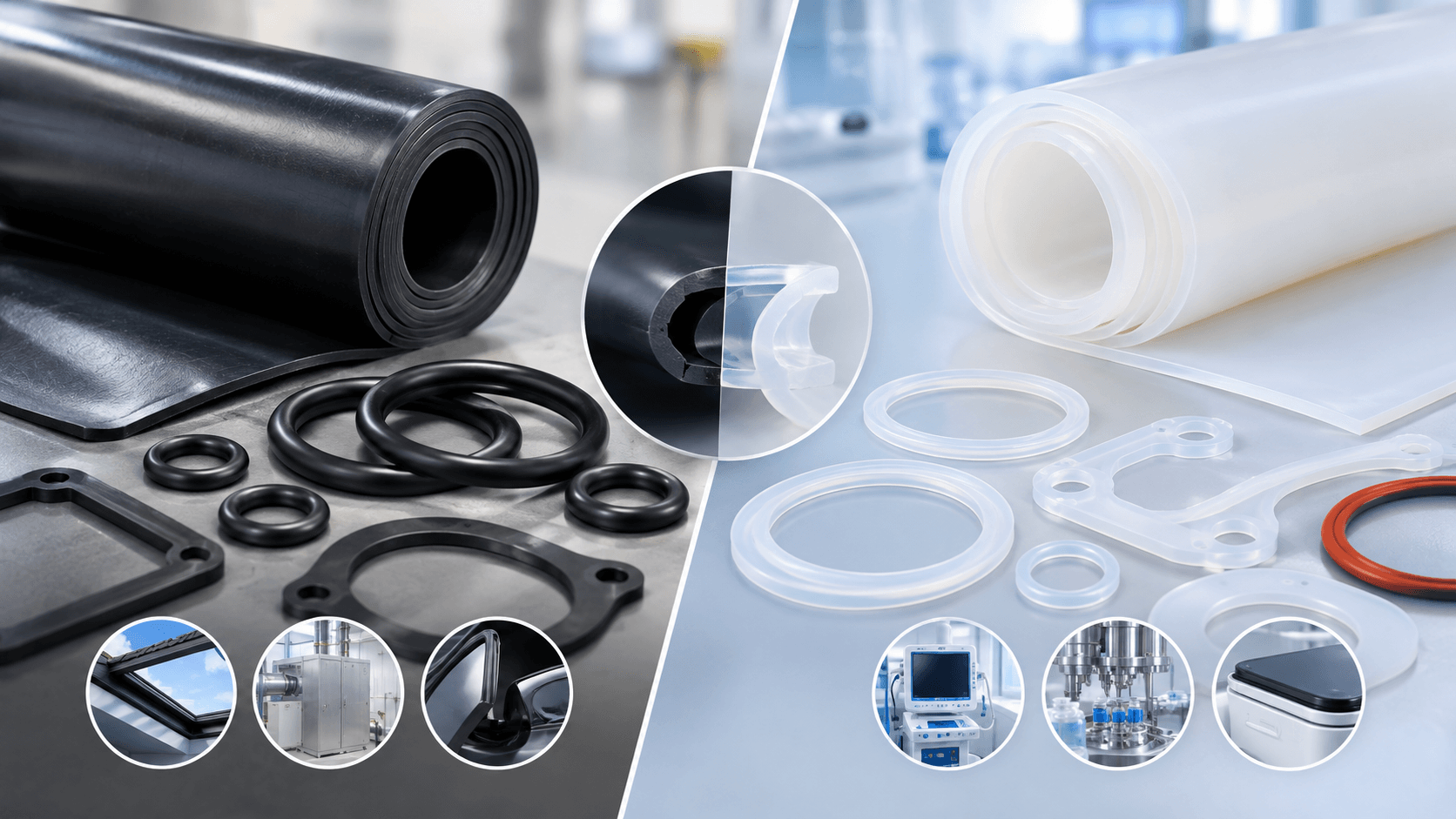
- Silicone rubber (SR). Non-reactive and stable from −55 to 300 °C, which is why it appears in food-contact products, medical devices, electronics and automotive parts. Silicone typically has lower tear strength than many organic rubbers, so wall thickness and corner radii deserve attention.
- Butadiene rubber (BR). Known for abrasion resistance, low heat build-up and resistance to cracking, and widely used in tyre treads. In practice it is often blended with other rubbers, so ask what the compound actually contains.
- Styrene butadiene rubber (SBR). Good abrasion resistance and ageing stability, provided it is protected by additives. The styrene-to-butadiene ratio sets the feel: more styrene gives a harder, less rubbery compound.
- Fluorkautschukmaterial (FKM). A high-fluorine rubber with excellent heat, chemical and oil resistance, used for gaskets, seals and O-rings in automotive, aerospace and chemical processing. Specify it where the environment demands it, not as a default.
- Non skid rubber (NSR). A textured rubber built to add traction and prevent slipping, used in flooring, mats and safety footwear, and in gyms, industrial settings and outdoor areas where wear, moisture and chemicals are present.
- Hydrogenated nitrile butadiene rubber (HNBR). A modified NBR with better heat, chemical and ageing resistance, high tensile strength and flexibility. Typical uses are seals, gaskets and O-rings in oil and gas, automotive and aerospace.
How to Read the Resistance Comparison Chart
The Materials page includes a chart that rates ten of these materials on six factors. Use it as a shortlist tool, not a final answer.
- Start with the two factors that will actually cause failure. For a car-interior seal that may be heat and weather. For a kitchen foot it may be skid and tear.
- Remember what the chart leaves out. It covers weather, heat, flame, skid, oil and tear resistance across ten materials. HNBR and NSR are described on the page but are not rows in the chart.
- Confirm the shortlist against your real fluid and temperature. A rating is a starting point for a conversation with an engineer, not a release for tooling.
Why This Is a Process Question, Not Just a Material Question
Two parts in the same polymer can behave very differently once compounding, cure and tooling are involved. A partner that does its own compounding, tooling and moulding can tell you what a material will do in your part, not just in a brochure.
A wrong material at the spec stage costs a design review. The same mistake caught at first-article inspection costs a tooling revision. Caught after production ramp, it costs a field failure. The difference isn't the material list. It's whether someone checked the material against your application before the tool was cut.
Unsure which material fits? Contact our team or email info@silcotechindustry.com to talk through your specific application.