Butyl Rubber (IIR) vs. Silicone Rubber: How to Avoid Costly Sealing Material Mismatches
Published on 7th Oct 2026
Butyl Rubber (IIR) vs. Silicone Rubber: How to Avoid Costly Sealing Material Mismatches
Butyl rubber (isobutylene isoprene rubber, or IIR) looks like an easy answer on a datasheet. It offers very low gas permeability, good electrical insulation and strong ozone resistance. In production, it is one of the elastomers most often chosen for one headline property and then asked to do five other jobs it was never suited for. The result is a swollen rubber seal in a fuel-adjacent assembly, a compression-set failure after a heat soak, or a closure that holds gas beautifully and then won't bond to its metal insert.
This matters most for design engineers, quality engineers and sourcing teams who specify rubber seals, gaskets, closures or barrier components, and who are weighing butyl (IIR) against silicone rubber or another elastomer. The risk gets baked in early. Butyl's strengths are real and easy to cite, so the material gets locked into a drawing before anyone maps the full duty cycle, and by the time the failure is visible, tooling is already cut.
What Butyl Rubber Actually Is
Butyl rubber, often just called "butyl," is a synthetic copolymer of isobutylene and isoprene. The abbreviation IIR stands for isobutylene isoprene rubber. It is made by polymerizing roughly 98% isobutylene with roughly 2% isoprene. First produced in 1937, its first major application was tyre inner tubes, and it remains the benchmark airtight rubber (Britannica).
The isobutylene portion is polyisobutylene (PIB, or polyisobutene), the homopolymer of isobutylene (2-methyl-1-propene) on which butyl is based. Structurally, PIB resembles polypropylene, but with two methyl groups on every other carbon atom rather than one. Raw PIB is a colourless to light yellow, viscoelastic material, generally odourless and tasteless.
That structure explains both the strengths and the limits. The densely packed methyl groups hold the polymer chains tightly, which is why gas and moisture move through butyl so slowly. The small isoprene fraction supplies the only double bonds available for sulfur vulcanization, which is why butyl cures slowly and why its aging behaviour shifts with isoprene content.
The Pain Point: A Material Chosen for One Property
A butyl seal that passes a gas-retention test can still fail the application. The failures rarely show up in the first sample run. They show up after thermal cycling, after contact with a lubricant nobody listed on the spec, or after a bonding step that worked on the bench and not on the line.
- Swelling after fluid contact. Butyl is not compatible with mineral oil and grease, fuels or chlorinated hydrocarbons (Parker O-Ring & Engineered Seals). A seal that sits near a lubricated mechanism can swell and lose its sealing force within weeks.
- Seal relaxation under heat. Compression set is only fair to good in many butyl compounds (Robinson Rubber selection guide), so a gasket that sealed at assembly can lose preload after sustained temperature exposure.
- Adhesion problems at metal inserts. Rubber-to-metal bonding with butyl is generally difficult, and some supplier guidance rates it as unsuitable. Overmoulded or bonded designs need that confirmed early.
- Cold or hot excursions outside the window. Standard IIR is typically rated from about -40 °C to +120 °C, with some sources quoting roughly -59 °C to +121 °C for good grades (Seal & Design). Silicone is rated to a considerably higher ceiling. A part exposed to both extremes can fall outside butyl's comfortable range.
The hidden cost is diagnostic time. Teams spend weeks chasing a leak path or a dimensional drift in the housing, when the real variable is a material that was selected against a single property.
Where Butyl Selection Actually Breaks Down
- Gas barrier treated as the only requirement. Butyl's low gas permeability is the reason it is specified, and it is genuine. Supplier data puts its gas diffusion at roughly an order of magnitude below natural rubber. But barrier performance says nothing about heat ageing, set, or fluid resistance, which usually decide field life.
- Fluid list written from memory. Butyl resists hot water, steam, polar solvents, glycol-based brake fluids, phosphate-ester hydraulic fluids and silicone oil. It does not resist petroleum oils or fuels. If the fluid list on the spec is incomplete, the material can be wrong from day one.
- Temperature window assumed, not tested. Butyl's stated range is narrower than silicone's. Heat soak at the upper end accelerates compression set, and the low end is limited compared with silicone grades rated much colder.
- Cure system mismatch. Standard butyl is sulfur-cured through its small isoprene fraction. Halobutyl grades (bromobutyl and chlorobutyl) cure faster and are preferred where precise curing and cleanliness matter, such as pharmaceutical closures. Specifying "butyl" without naming the grade leaves the cure chemistry to chance.
- Isoprene content ignored. Weather and ozone resistance fall as isoprene content rises. Two compounds both called IIR can age very differently outdoors.
- Bonding and overmoulding assumed to carry over. Designs that rely on a bonded insert or a multi-material assembly cannot assume butyl will behave like silicone or EPDM at the interface. For bonded or co-moulded designs, prove the interface on a sample first.
- Appearance and colour overlooked. Compounded butyl is typically black. If the part needs to be translucent, colour-coded or visually inspected, that constraint belongs in the spec before the material is chosen.
Butyl Rubber vs. Silicone Rubber: Properties at a Glance
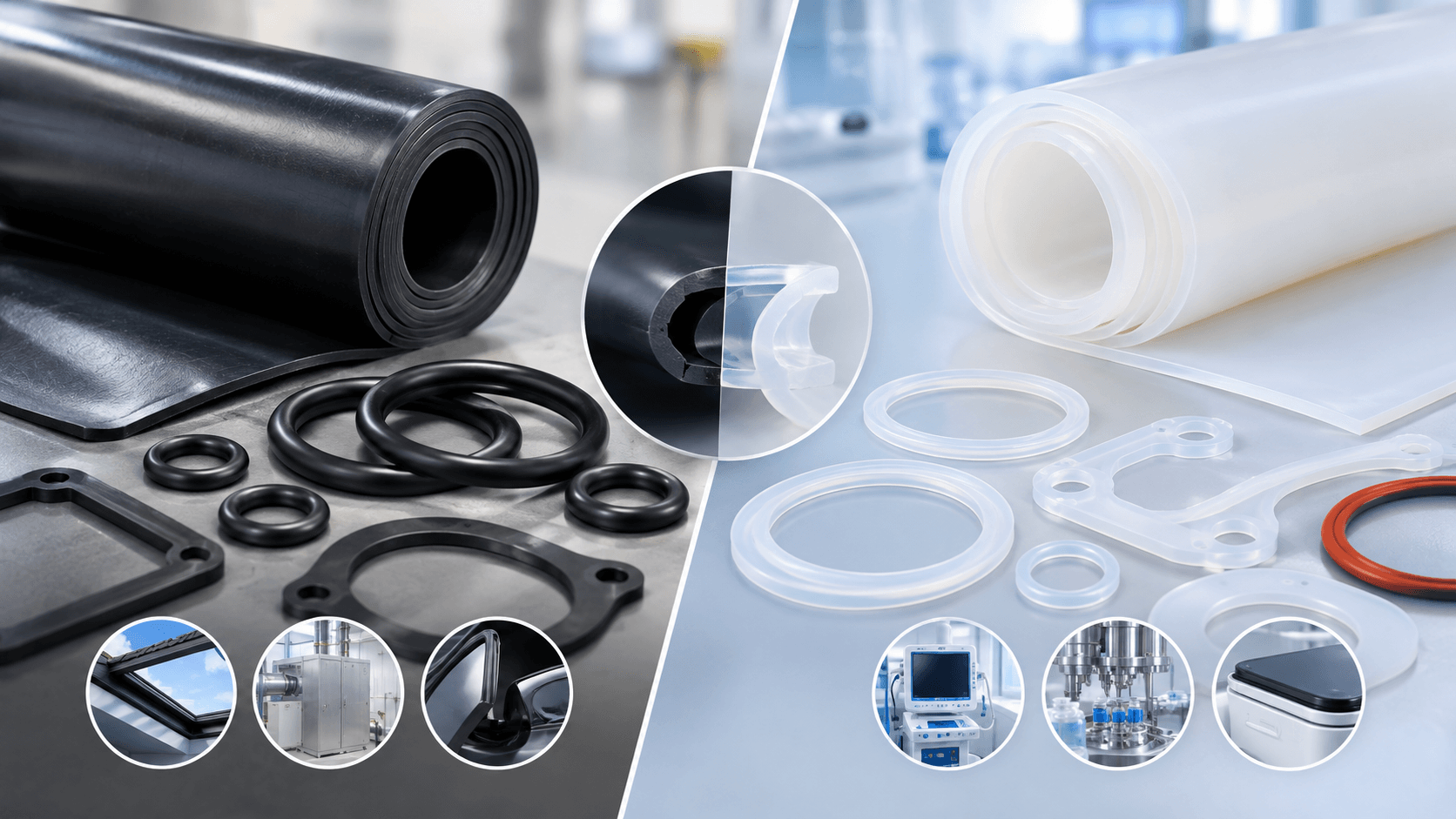
The table below compares typical values for standard butyl against liquid silicone rubber (LSR). Figures vary by grade and compound, so treat them as a screening guide and confirm them on your own compound.
| Property | Butyl rubber (IIR) | Silicone rubber (LSR) |
|---|---|---|
| Gas and moisture permeability | Very low, which is why it is used for tyre inner tubes and airtight seals | Comparatively high; not chosen as a gas barrier |
| Typical service temperature | About -40 °C to +120 °C for standard IIR; halobutyl grades to roughly -60 °C to +130 °C | Commonly cited up to about +250 °C; some compounds flexible to about -90 °C |
| Mineral oil and fuel | Not compatible | Test before specifying; hydrocarbon fluids can swell silicone |
| Compression set | Fair to good | Generally good, compound dependent |
| Colour and translucency | Typically black | Clear, translucent or colour-coded |
| Typical processing | Sulfur cure; halobutyl cures faster | LSR injection moulding for repeatable, high-volume parts |
| Healthcare use | Halobutyl is common in pharmaceutical closures | Medical-grade silicone for wearables and surgical components |
Sources: Parker, Robinson Rubber, Seal & Design and Danco elastomer notes.
What Prevents This: Specify the Whole Duty Cycle
Each failure point above has a direct counter, and they map one for one.
- Write the barrier requirement as a number. State the permitted leak rate, gas species and pressure, so butyl is chosen because it meets a measurable target and not because it is known as "the low-permeability rubber."
- List every fluid the part will touch. Include lubricants, cleaning agents and sterilants. Compatibility is checked against the full list, not the primary medium.
- Define temperature as a cycle, not a point. Give the hot soak, the cold start and the dwell time at each, then validate compression set at the worst case.
- Name the grade and cure system. Standard IIR, bromobutyl or chlorobutyl, with the target hardness (butyl compounds commonly span roughly 40 to 90 Shore A).
- Confirm isoprene content for outdoor or long-life parts. Ask for it on the compound data sheet.
- Test the bond or the interface before tooling. If the design needs adhesion or overmoulding, prove it on a sample.
- Settle appearance early. Colour, translucency and visual inspection requirements go in the first spec draft.
Where gas barrier is not the deciding requirement, and the duty cycle involves higher heat, a wider temperature swing, or a need for colour and translucency, silicone rubber is often the lower-risk choice, and LSR injection, extrusion and compression moulding cover most seal and gasket geometries. Where barrier performance genuinely drives the design, butyl earns its place, provided the rest of the list has been checked against it.
Why This Is a Partner Question, Not Just a Datasheet Question
A datasheet tells you what a material can do under test conditions. It does not tell you whether it fits your part. A precision rubber manufacturer who has seen these failures before does things differently:
- Asks for the full fluid, temperature and assembly context before quoting a material, and runs a design-for-manufacturing review through tooling and prototyping.
- Tests compression set and fluid exposure on your actual compound and geometry, in-house, instead of relying on generic figures.
- Gives your engineers direct access to someone who can discuss trade-offs, not only a quotation.
- Handles a small spec change without a multi-week RFQ cycle.
The Cost of Catching It Late
A material mismatch caught at the spec stage costs a design review. The same mismatch caught at first-article inspection costs a tooling revision. Caught after production ramp, it costs a field failure and a recall conversation. The difference isn't butyl versus silicone. It's whether the material was chosen against your real duty cycle or against one property on a datasheet.
Weighing butyl rubber against silicone rubber for a seal, gasket, closure or barrier part? Contact our team or email info@silcotechindustry.com to talk through your specific application.