Controlled Environments for Critical Manufacturing in SEA: How Silcotech Resolves the Contamination Challenge
Controlled Environments for Critical Manufacturing in SEA: How Silcotech Resolves the Contamination Challenge
The global cleanroom technology market is on a steady climb, projected to grow from USD 10.72 billion in 2026 to USD 14.88 billion by 2031, a 6.78% compound annual growth rate, with Asia-Pacific expanding even faster at 7.32% a year as semiconductor and medical-device output scales across the region. Every additional billion in that figure represents facilities that must now hold a specific particle count, a specific humidity band, and a specific personnel protocol, every hour of every production day.
The manufacturing reality, however, is considerably more complicated.
A component that leaves a controlled environment carries more than its physical dimensions. It carries a temperature history, a humidity exposure record, a particle-count log at the moment of moulding, and a chain of personnel-gowning records that a quality auditor or a regulator may ask to see months later. For a rubber or silicone part destined for a catheter tip, an implantable housing, or a sealed electronics enclosure, a single excursion outside the specified range, even briefly, can mean a rejected lot, a delayed submission, or a field failure long after the part has shipped. Each of those outcomes has its own cost, and none of them is visible on the part itself.
The core problem: most rubber and silicone manufacturers treat the cleanroom as a separate room bolted onto a conventional production line rather than as an integral part of the process. That separation shows up three ways for OEMs: environmental data that is recorded but not tied to the specific mould shot it protects, personnel and material protocols that vary between shifts or suppliers, and a testing step that happens after the part has already left the controlled space, when a contamination event can no longer be traced back to its source.
Silcotech Industry, a precision liquid silicone rubber and elastomer manufacturer based in Kedah, Malaysia, and certified to ISO 9001 and ISO 13485, builds its Class 8 and Class 9 cleanroom capability into the same facility as its moulding, tooling, and testing operations. This article explains why controlled-environment manufacturing is harder than a facility brochure suggests, and how an integrated model resolves the contamination and traceability risk that a fragmented supply chain leaves with the OEM.
The Contamination Problem in SEA
A Controlled Environment Is a Process, Not a Room
Contamination control is often described as an infrastructure question: install the filtration, seal the walls, gown the staff. In practice, the room is the easy part. The harder part is holding the environment steady through every stage a part passes through — material staging, mould loading, cure, demoulding, inspection, and packaging — without a single handoff introducing a variable the original specification did not anticipate.
A silicone part cured in a controlled environment but demoulded, trimmed, or packed in an uncontrolled one has effectively lost the benefit of the cleanroom. This is the gap that shows up in audits: a facility that can prove its cleanroom classification but cannot prove that a specific part never left the classified zone between moulding and final packaging.
Cleanliness Requirements Are Not One Standard
OEMs sourcing rubber and silicone components for medical, electronics, or food-contact use are rarely working against a single specification. Each market and application layers its own requirement on top of the base cleanroom classification, and the gap between "clean" and "clean enough for this specific product" is where risk concentrates.
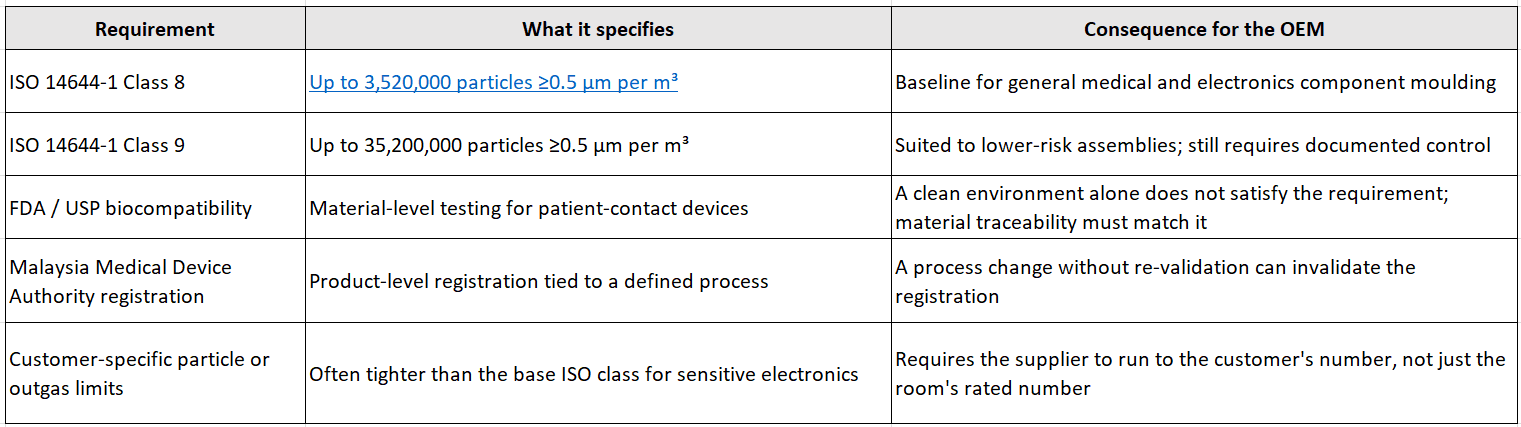
The table shows why a single cleanroom classification is a starting point, not an answer. An OEM that specifies "Class 8" without also specifying the material, biocompatibility, and registration requirements that ride alongside it is likely to receive a part that is clean but not necessarily compliant for its intended use.
Personnel and Material Discipline Determine the Outcome
Air filtration and pressure cascades control what moves through the space. They do not control what people and materials carry into it. Gowning protocol, material staging sequence, and the discipline of not introducing an unvalidated component mid-run are what actually hold a classified environment to its rating day to day, and they are the variables most likely to drift when a facility is under schedule pressure or running with agency labour. The risk is not occasional; it is structural — it recurs at every shift change and every new operator, unless the protocol is designed to be followed by default rather than by vigilance.
Why Malaysia Is the Right Manufacturing Base for Controlled Environment Manufacturing
Malaysia's position in this supply chain is not incidental. The country's medical-device exports reached RM34.54 billion in 2025, and government policy is now pushing the sector from contract manufacturing toward higher-value design and process ownership — a shift that raises, rather than lowers, the bar for the contamination control and documentation a domestic supplier must be able to demonstrate.
Structural Advantages
- An established medical-device ecosystem. Malaysia already hosts a dense network of medical-device manufacturers and their supply base, which means auditors, regulators, and logistics providers are familiar with the documentation controlled-environment manufacturing requires.
- Regulatory alignment with major markets. Malaysian manufacturers commonly hold FDA, CE, and ISO 13485 credentials side by side, reducing the re-qualification burden for OEMs selling into multiple regions from one source.
- Kedah's proximity to Penang's electronics and semiconductor corridor. A cleanroom-capable rubber and silicone supplier based in Kedah sits close to customers who already run their own classified environments and expect a supplier to speak the same language.
- Port and logistics access. Northern Malaysia's port infrastructure supports the export volumes the medtech sector is now targeting, without adding handling steps that could compromise a sealed or sterile-barrier component.
- Policy continuity. Sustained government investment in the medtech sector signals a stable base for OEMs making multi-year sourcing decisions rather than short-term capacity plays.
Key insight: a cleanroom classification only protects a product for as long as the surrounding ecosystem — regulation, logistics, workforce — can support the documentation trail behind it. Malaysia's medtech infrastructure is what makes that trail credible, not the cleanroom alone.
How Silcotech Supports Controlled Environment Manufacturing
For a rubber or silicone part destined for a regulated application, environmental control is not a value-added service layered on top of moulding; it is a condition the moulding process itself depends on. Compression set, cure consistency, and surface finish are all sensitive to the temperature and humidity swings that an uncontrolled environment permits, before contamination is even considered. Treating the cleanroom as integral to the process, rather than a separate finishing step, is what keeps those two risks — process variation and contamination — from compounding each other.
End-to-End Manufacturing for Controlled Environments
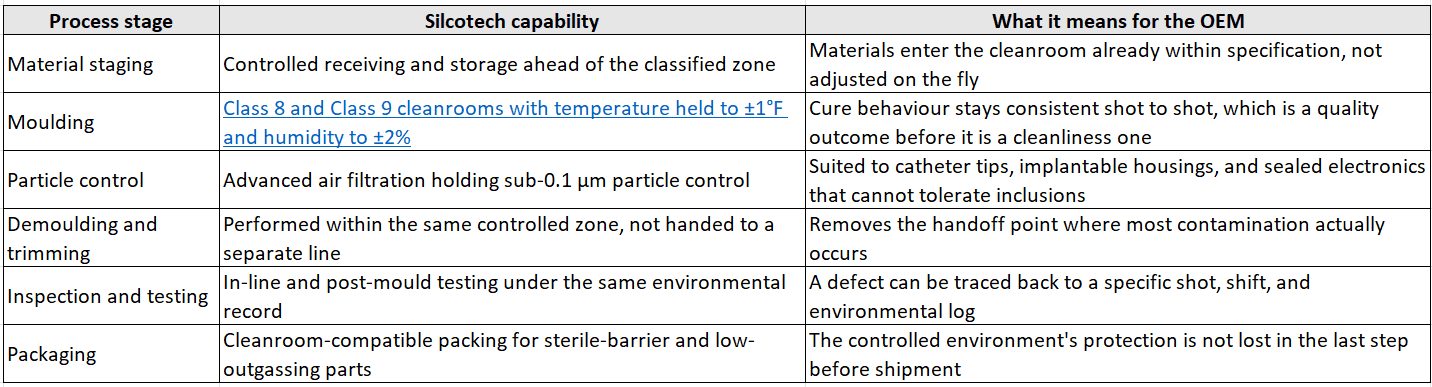
The table supports is a simple one: most contamination events are not traced to a single dirty room. They are traced to the point where a part crosses from one team, one line, or one environmental record to another, and no single party owns what happened at that boundary. Keeping material staging, moulding, demoulding, inspection, and packaging inside one facility and one environmental record removes most of those boundaries before they can become a root-cause investigation.
Handling the Regulated Reality
Medical and precision electronics customers rarely order a single high-volume part and leave it unchanged for years. Silcotech's cleanroom capability is built to support the variation that regulated and high-mix production actually involves:
- Biocompatible material qualification run alongside the environmental controls the material will be moulded in, not as a separate downstream check.
- Process validation tied to the specific mould and cleanroom class, so a change to either triggers a documented re-validation rather than an assumption of continued compliance.
- Low-outgassing production discipline for parts destined for sealed electronic housings, where off-gassed compounds can affect neighbouring components long after assembly.
- Documentation built for audit, with environmental logs structured to answer a regulator's or customer's question about a specific lot, not just a general facility rating.
How Silcotech Resolves Contamination Risk for OEMs in SEA
Resilience against contamination has to be designed into the process before a lot is at risk, not added after a deviation report is filed. Three mechanisms carry most of that weight.
Environmental Control and Monitoring
Temperature held to ±1°F and humidity to ±2%, with particle control below 0.1 µm, gives the moulding process a stable window rather than a target it drifts toward and away from across a shift. Monitoring that is continuous, rather than spot-checked, is what turns a classification rating into a defensible record when a customer asks for evidence months after shipment.
Personnel and Material Protocols
Strict gowning, staging, and material-movement protocols are treated as part of the manufacturing process specification, not a site-safety add-on. This is the layer that FED-STD infrastructure alone cannot guarantee, because filtration controls the air, not the people and materials moving through it.
Process Validation Before Volume
Design for manufacturability and mould-fill simulation are run against the actual cleanroom conditions a part will be produced in, so that a process proven at qualification behaves the same way at volume. This is the same DFM discipline Silcotech applies across its precision LSR injection, extrusion, and compression moulding work, extended into the cleanroom's specific environmental variables.
Operational reality: an OEM evaluating a cleanroom supplier should ask not just for the ISO class on the wall, but for the environmental log tied to their specific part number. A supplier that can produce one on request has actually built the traceability the classification implies.
Applications Silcotech Supports
Medical Devices
Catheter tips, seals, housings, and grommets for fluid-control and diagnostic devices depend on both biocompatibility and dimensional consistency that only a controlled moulding environment can sustain across a production run. Implantable components carry the additional requirement of documented biocompatibility testing tied to the exact material lot used.
- Catheter tip and fluid-path seals
- Diagnostic device housings and grommets
- Implantable silicone components
- Wound-care and skin-contact silicone parts
Electronics
Overmoulded elastomer switch buttons and sealed housings for wearable and monitoring devices need cleanroom production to prevent particle inclusion that would otherwise show up as a field failure long after the device has shipped.
- Overmoulded switch buttons and keypads
- Sealed enclosure gaskets for wearable monitors
- Antistatic and conductive elastomer components
- Low-outgassing seals for sensitive electronic assemblies
Consumer and Industrial
Not every controlled-environment application is medical. Consumer products with skin contact, and industrial components destined for cleanroom-adjacent equipment, benefit from the same particle and material discipline even where the regulatory bar is lower.
- Skin-contact consumer silicone parts
- Food-graded rubber components
- Precision seals for cleanroom-adjacent industrial equipment
The Integration Advantage for Quality and Speed
A fragmented supply chain forces the OEM to stitch together evidence from separate vendors after the fact — one for moulding, one for cleanroom finishing, one for testing — each with its own environmental record and its own definition of "controlled." Silcotech's model keeps that evidence under one roof from the first shot to the final pack.
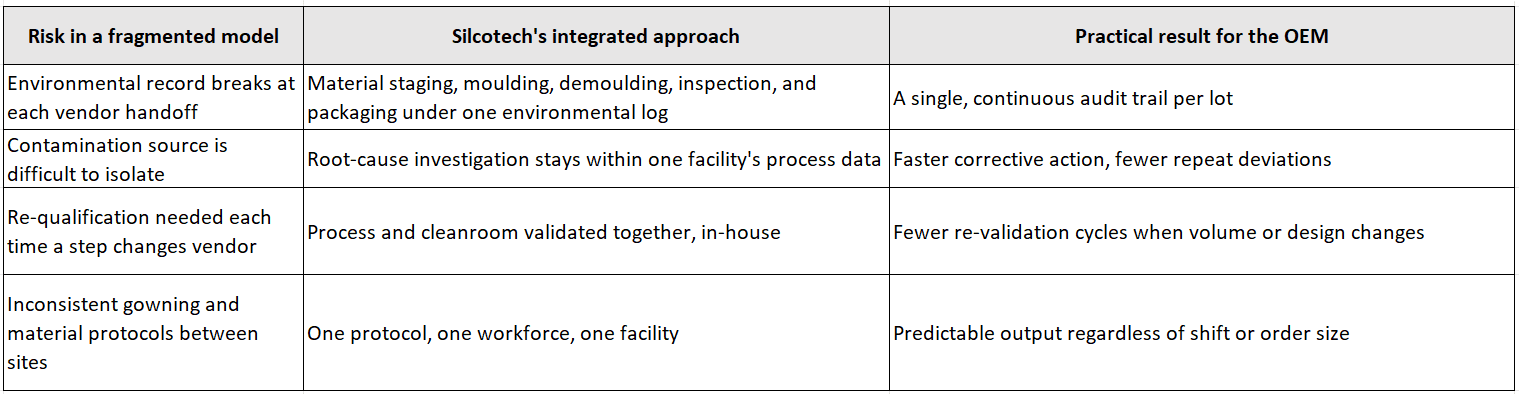
Shorter root-cause cycles and fewer re-qualification events compound into a commercial advantage that a facility brochure does not capture: an OEM moving from prototype to production volume typically needs fewer re-spins and reaches yield stability faster when the same team that qualified the process is the team running it at scale.
Partnering with Silcotech for Controlled Environment Manufacturing in SEA
The demand signal for contamination-controlled manufacturing in Southeast Asia is real, and Malaysia's medtech and electronics base gives OEMs a credible reason to source from the region rather than around it. The structural challenge is equally real: a controlled environment only protects a product if the discipline behind it — personnel, materials, documentation — holds as tightly as the air filtration does.
- Class 8 and Class 9 cleanrooms built into the same facility as moulding, tooling, and testing, not bolted on as a separate step.
- Environmental control held to ±1°F and ±2% humidity, with particle control below 0.1 µm, monitored continuously rather than spot-checked.
- ISO 9001 and ISO 13485 certification, with medical-grade products aligned to FDA, USP, and ISO standards.
- In-house DFM and mould-fill simulation run against actual cleanroom conditions before a process is scaled to volume.
- A single environmental record per lot, from material staging through to packaging, that can answer an auditor's question about a specific part rather than a general facility rating.
The question for an OEM sourcing a rubber or silicone component for a regulated application is not whether contamination risk exists in the supply chain. It is whether that risk is managed across several disconnected vendors, or engineered out inside one facility built to hold the line from the first shot to the final pack. To discuss a specific application, contact Silcotech or review the cleanroom manufacturing capability in detail. For related work on components engineered for demanding environments, see Silcotech's engineered silicone for ATEX Zone 0 applications.