Custom Moulded Rubber Parts in SEA: How Silcotech Resolves the Material and Compound Selection Challenge
Published on 22th October 2026
Custom Moulded Rubber Parts in SEA: How Silcotech Resolves the Material and Compound Selection Challenge
Moulded rubber rarely makes headlines, yet it sits inside almost every product that seals, cushions, grips or insulates. One published market estimate puts the global rubber moulding market at USD 47.16 billion in 2025, rising to USD 75.19 billion by 2034, a compound annual growth rate of 5.32%. Publishers do not agree on the starting point. Another estimate values the market at USD 37.8 billion in 2023 and forecasts a 7.8% CAGR to 2032. They agree on the direction: automotive, healthcare, electronics and industrial demand keep pulling the same way.
The manufacturing reality is less tidy than the growth curve.
A moulded rubber part looks like the simplest line on a bill of materials. In practice, one part depends on the base polymer, the fillers and plasticisers compounded into it, the cure system, the venting and gate design of the mould, the tolerance stack against a mating housing, the heat, oil, ozone or chemicals it will meet in service and, for medical or infant-care use, the documentation that follows it into the customer's audit file. Each of those has its own qualification cycle. A shortfall in any one can surface as a leak, a split grommet, a failed audit or a field return months after the part shipped.
The core problem: custom rubber parts are often specified as if the material name settles the question, then sourced from separate compounders, toolmakers and moulders who each own one step. When something fails, nobody owns the whole chain. For OEMs that means slow root-cause work, repeated tooling spend, and production parts that behave differently from the samples that were approved.
Silcotech Industry, based in Sungai Petani, Kedah, has supplied precision rubber components since 2006 and holds ISO 9001 and ISO 13485 certification. This article explains why moulded rubber parts go wrong, why Malaysia is a sound place to make them, and how Silcotech's approach, from compound formulation through tooling to mass production, takes that risk off the OEM's desk.
The Moulded Rubber Parts Problem in SEA
The Material Name Is Not the Specification
Writing "NBR" or "EPDM" on a drawing narrows the field. It does not define the part. Silcotech's materials guide makes the point for EPDM: the material is always used compounded with fillers such as carbon black and plasticisers such as paraffinic oils, and only has useful rubbery properties once it is cross-linked. Two parts that are both called EPDM can behave very differently depending on the recipe behind them. The same holds across the range.
The table below summarises how common elastomers differ, using the descriptions on Silcotech's materials page.
| Material | Characteristic (as described by Silcotech) | Consequence for the OEM |
|---|---|---|
| Natural rubber (NR) | Large stretch ratio, high resilience, highly waterproof | Strong choice for flexible, resilient parts; cost follows a commodity market |
| Nitrile (NBR) | Used for fuel and oil handling seals and grommets; −40 to 108 °C | Suits oil and fuel contact; narrower temperature window than silicone |
| Chloroprene (CR) | Resists ozone cracking, heat ageing and many chemicals; moderate to poor against acids, solvents and fuels | Good for weathering; wrong choice where fuel or solvent contact is likely |
| Fluoroelastomer (FKM) | Excellent heat, chemical and oil resistance | Suited to seals and gaskets in extreme conditions |
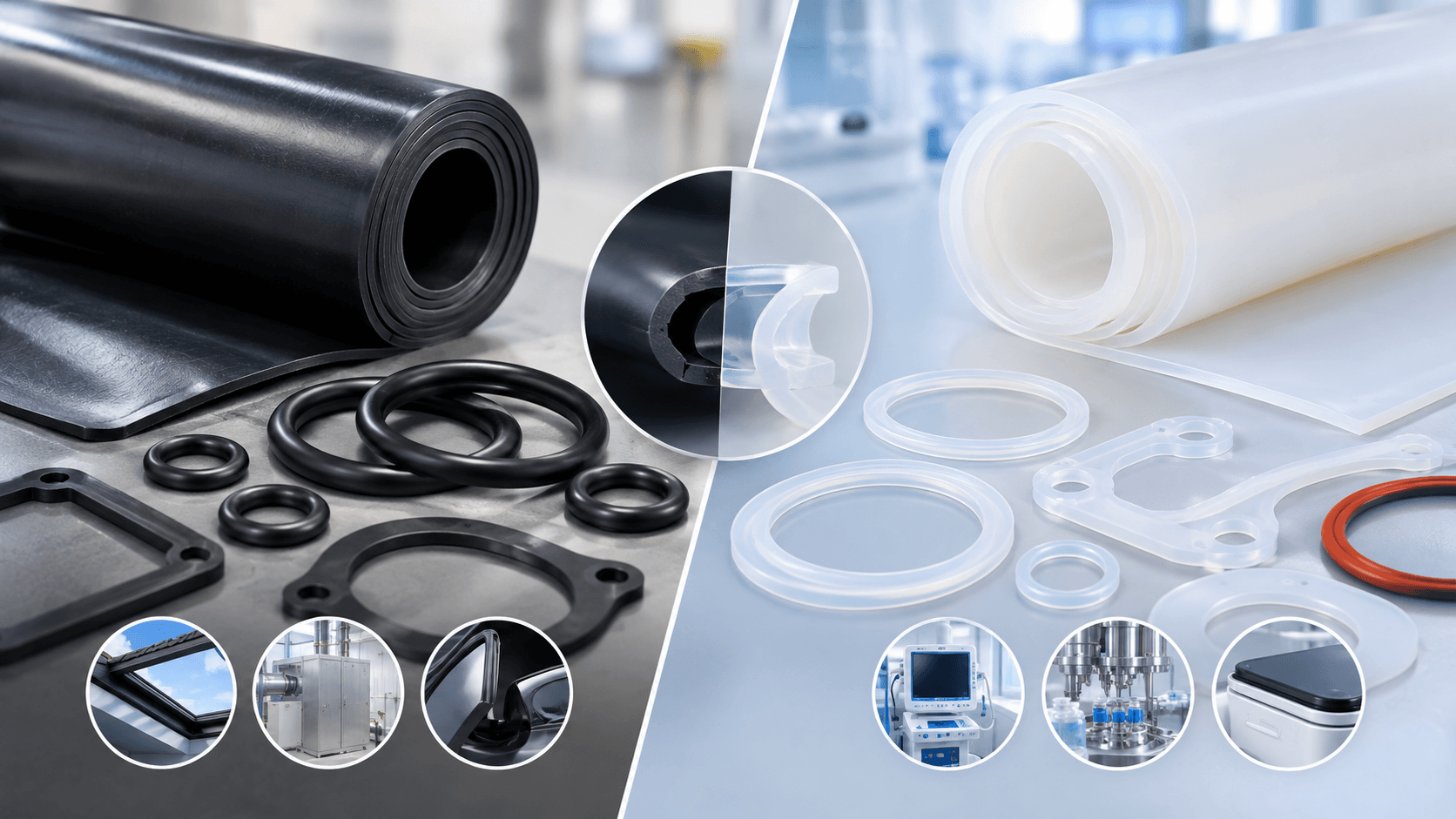
| Silicone (SR) | Stable and non-reactive from −55 to 300 °C | Suits medical, food and wide-temperature duty |
| EPDM | Always compounded with fillers and plasticisers, and cross-linked | Recipe, not polymer name, decides real performance |
The table shows why a material callout alone leaves room for error. Choosing between these families means weighing weather, heat, oil, flame, skid and tear resistance together, which is the comparison Silcotech's resistance chart on the materials page sets out. A compound that gains oil resistance usually gives something up elsewhere, and that trade-off has to be made against the real application, not a data-sheet headline.
Commodity Inputs, Custom Outputs
Natural rubber also trades as a commodity. Department of Statistics Malaysia figures show scrap prices falling 15.8% in a single month, from 761.92 sen per kg in March 2025 to 641.27 sen per kg in April 2025. Swings like that do not change a drawing, but they change quotes. An OEM that treats rubber as a fixed-price line item will keep being surprised, and one that locks a single compound with a single compounder has little room to respond.
Samples That Pass, Production That Drifts
A hand-made sample and a mass-produced part are not the same object. Cure time, mould temperature, venting and material batch all move once volumes rise. A gasket can pass first-article inspection and still lose sealing force after months under heat, because the compound's compression set was never checked against the real operating condition. A grommet can fit the prototype and bind in production because tolerance and hardness were agreed in separate conversations.
The risk sits in the handoffs between steps, not in any single part.
Why Malaysia Is the Right Manufacturing Base for Moulded Rubber Parts
Malaysia's rubber industry is broader than most buyers assume. An industry body, Margma, reports RM33.7 billion in rubber product exports, of which gloves accounted for RM15.41 billion, or 45.8% [VERIFY: confirm the reporting year, likely 2024, before publishing]. That leaves roughly RM18.3 billion in non-glove rubber products. On the medical side, the Association of Malaysian Medical Industries says Malaysia has the largest medical device market in Southeast Asia, at RM10.6 billion in 2023.
Structural Advantages
- An established rubber industry. Export data shows a sector that reaches well beyond a single product line, which gives OEMs a deeper pool of suppliers, skills and compounding know-how.
- Visible raw material data. The national statistics office publishes monthly natural rubber production, stocks, exports and prices, so buyers and processors can see market movement instead of guessing at it.
- A growing medical device base. The same release notes that the medical device sector was prioritised in the Twelfth Malaysia Plan and the New Industrial Master Plan 2030, which supports demand for medical-grade rubber and silicone parts.
- Material, tooling and moulding in one company. Silcotech runs in-house R&D, tooling design and material formulation through to mass production from Sungai Petani, so material and tool decisions are made by people who talk to each other daily.
How Silcotech Supports Custom Moulded Rubber Parts
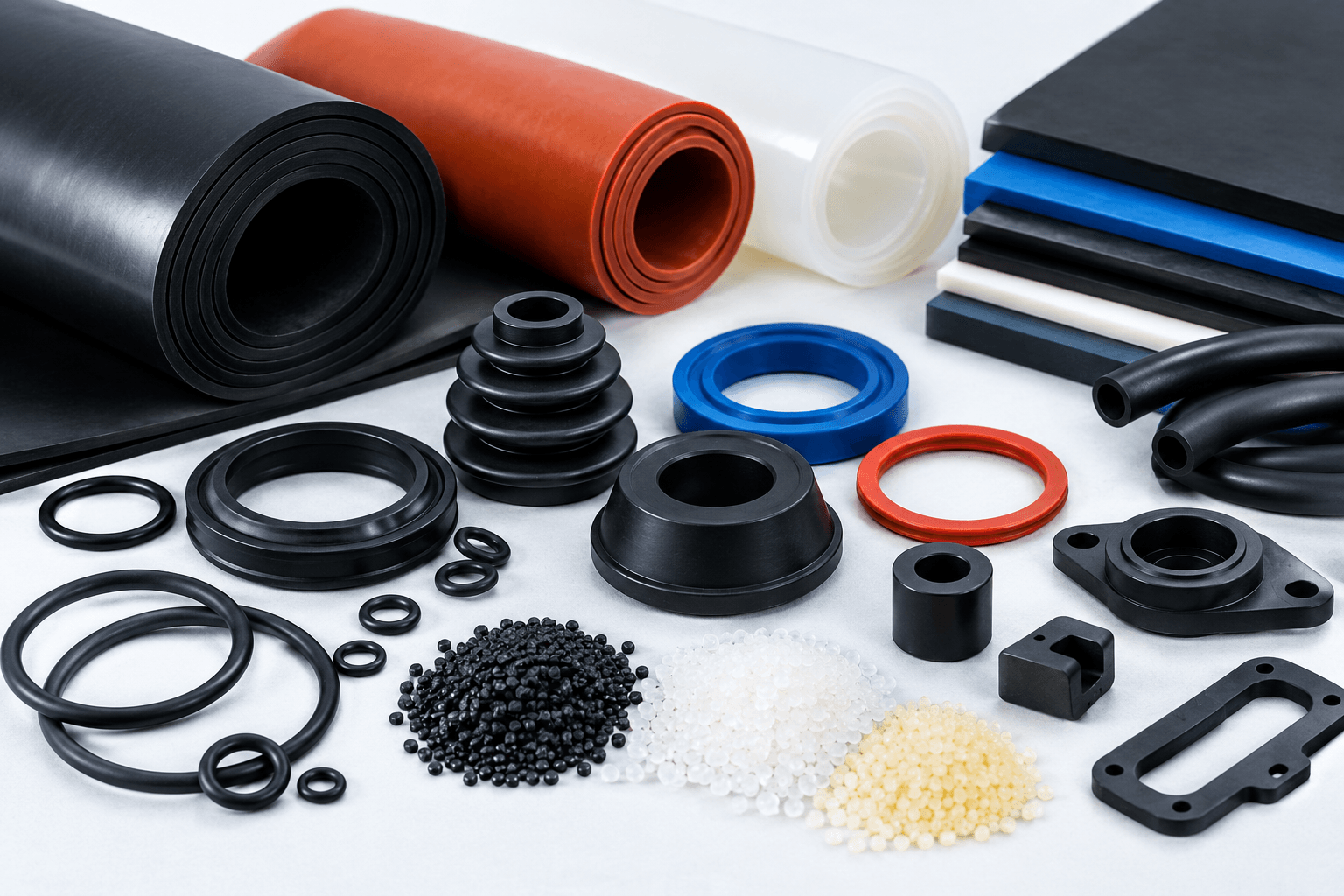
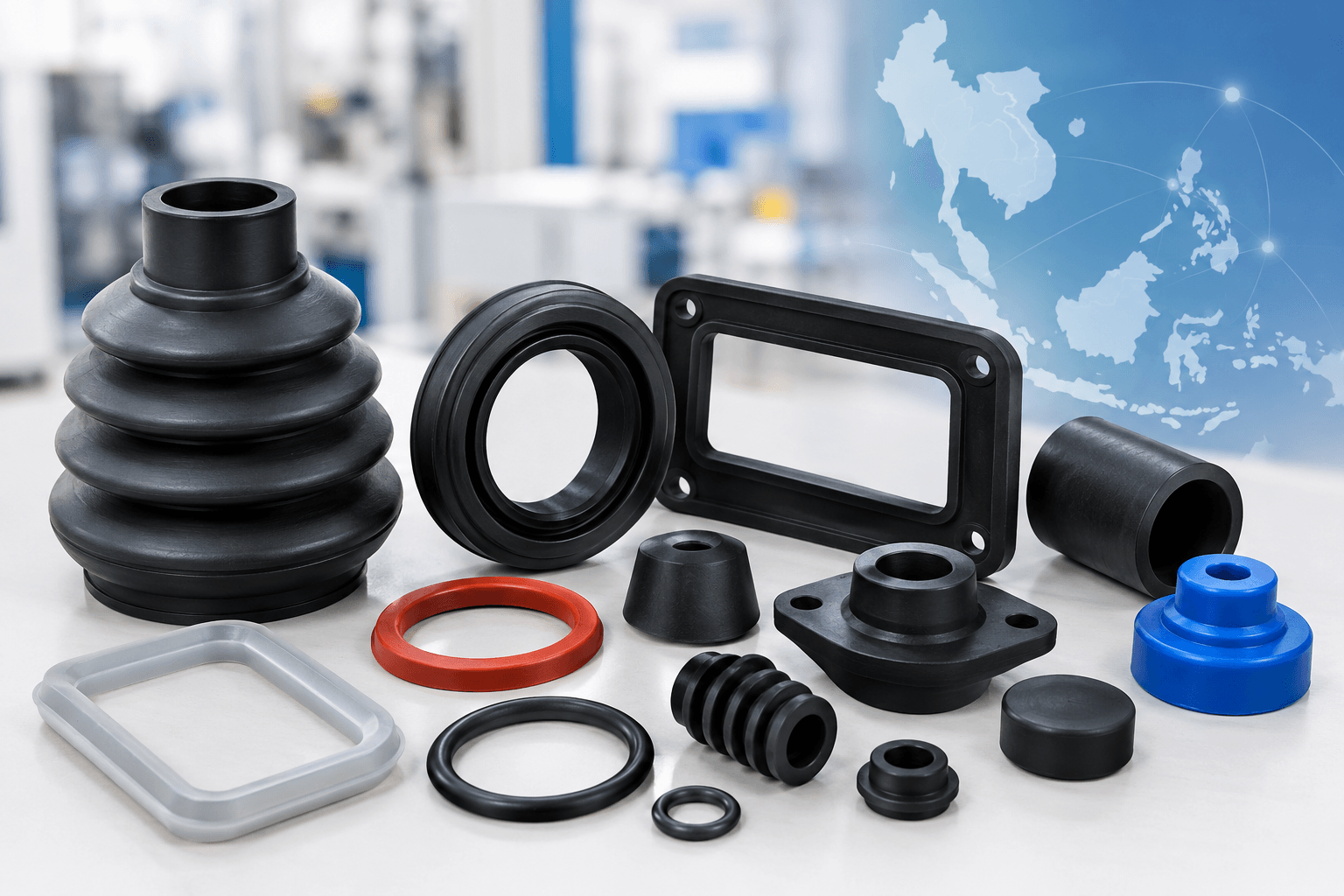
Silcotech's moulded rubber parts range combines natural and synthetic rubbers, from standard parts to fully customised ones, and relies on formulation and precision moulding to meet specific needs. For OEMs, the useful question is not which rubber is available. It is who takes responsibility when the compound, the mould and the application meet.
End-to-End Manufacturing for Custom Rubber Parts
Silcotech describes its service as end-to-end project manufacturing management. The table maps that onto the stages a custom part passes through.
| Process stage | Silcotech capability | What it means for the OEM |
|---|---|---|
| Material selection and formulation | Natural and synthetic rubbers, plus customer-specified materials enhanced with Silcotech compound formulations | The compound is matched to the application, not picked from a catalogue line |
| DFM and tool evaluation | Design for manufacture review, including mould-filling simulations | Fill, venting and wall-thickness problems found before steel is cut |
| Prototyping and tooling | In-house tooling design and prototyping, plus quick-turn soft tooling and samples | Faster design validation and fewer full-tool re-spins |
| Moulding | Precision moulding, with LSR injection, extrusion and compression moulding at tolerances from 0.08 mm to 0.15 mm | Repeatable parts that mate with the housing they were designed for |
| Clean production | Class 8 and Class 9 cleanroom manufacturing | Medical and hygiene-sensitive parts made in a controlled environment |
| Volume and compliance | Low to high volume manufacturing, with compliance testing and certification | One route from first sample to documented, repeatable production |
Most field failures do not come from one bad step. They come from the gap between two good ones: a compound approved on a data sheet, then moulded in a tool designed without knowing which compound would go in it. When formulation, tooling and moulding sit under one project team, root-cause work shortens because the people who made each decision can compare notes directly.
Handling the Custom and High-Mix Reality
Custom rubber work rarely arrives as a tidy, high-volume order. Silcotech's model is built around that.
- Customer-specified materials. OEMs that already qualified a material can bring it, and Silcotech's compound formulations are used to enhance it for the target application.
- Bespoke parts from first principles. Design, prototype and manufacture of fully custom rubber parts sit within the same offer.
- Special applications. Ad hoc and unusual demand, backed by tooling design expertise, is part of the work, not an exception to it.
- Low to high volume. The same team that built the prototype tool supports the move to higher volume.
How Silcotech Resolves Specification Risk for OEMs in SEA
Resilience in a rubber part is designed in before the first production run. It cannot be added after a return. Three mechanisms do most of the work.
Qualify the Material Against the Real Application
Selection starts from the operating conditions, not the material list: temperature range, fluids and fuels, ozone and weather exposure, contact with skin or food, sterilisation and repeated use. In one wearable electronics project, Silcotech sourced and evaluated 15 materials before selecting one on flexibility, durability and weather resistance. The pattern is the useful part: test several candidates against the use case, then commit.
Tune the Compound Instead of Compromising the Part
When a customer-specified material nearly fits, the answer is not always a different polymer. Formulation changes can move hardness, resilience or ageing behaviour while keeping the base material the customer has already qualified. This is where the "compound formulations" on Silcotech's product page earn their place: they close the gap between a general-purpose grade and a precise requirement.
Prove the Design Before the Tooling Spend
DFM review and mould-filling simulation catch trapped air, weld lines and uneven cure before they become scrapped parts. Quick-turn soft tooling then produces real samples for fit and function testing. The result is that expensive production tooling is cut once, against a design that has already been tested.
What to Send With an RFQ
A short list that helps any rubber moulder, Silcotech included, give a firm answer sooner:
- Operating window. Minimum and maximum temperature, and how long the part sits at each.
- Fluids and exposure. Oils, fuels, cleaning agents, UV, ozone or sterilisation cycles the part will meet.
- Mating parts. Housing material, critical dimensions and the tolerance the seal or grommet must hold.
- Hardness and feel. Target Shore hardness, plus any compression or deflection requirement.
- Regulatory category. Medical, food-contact or infant-care use, and the documentation the audit file will need.
- Volume ramp. Prototype quantities, first-year volume and any expected step-ups.
Moulded Rubber Parts Silcotech Supports by Industry
Silcotech's moulded rubber range serves five industries. The examples below come from its product page.
Medical
Medical components need to be hygienic, biocompatible and able to survive repeated sterilisation, which narrows the material and process choices quickly.
- Medical handles and valves for critical devices and equipment
- Parts described as biocompatible, non-toxic and safe for repeated use
- Components designed to withstand sterilisation processes
Electronics
Electronics rarely needs rubber for strength. It needs it for isolation, sealing and protection.
- Anti-vibration feet that reduce vibration, noise and impact in equipment
- Anti-slip, impact-resistant parts that stay stable under continuous load
- Related work in antistatic and conductive rubber for ESD protection
Consumer
Consumer parts touch skin, food and infants, so material safety and consistent feel matter as much as durability.
- Baby products described as BPA-free, non-toxic and safe for prolonged infant contact
- Silicone earbuds and accessories for portable audio devices
- Airtight food container components
Automotive
Automotive rubber lives with heat, fuel, ozone and weather, often hidden behind panels where replacement is expensive.
- Precision-moulded grommets and seals
- Parts described as weather, ozone and fuel resistant
- Components built for secure sealing in harsh conditions
Utility
Utility and industrial applications ask for gaskets and tubing that keep working under pressure and chemical exposure.
- Gaskets resistant to oil, heat and chemicals
- Silicone tubing that is flexible under pressure and heat
- Sealing components that hold reliably in demanding environments
The Integration Advantage for Quality and Speed
The strongest argument for an integrated model is easiest to see by comparing it with the fragmented alternative.
| Risk in a fragmented model | Silcotech's integrated approach | Result for the OEM |
|---|---|---|
| Compound chosen by one vendor, mould built by another | Formulation, tooling and moulding managed as one project | Fewer finger-pointing cycles when a part fails |
| Hardness and tolerance specified separately | DFM review looks at both against the mating part | Parts that fit and seal first time |
| Samples differ from production parts | Quick-turn samples and mass production run through the same process knowledge | Smaller gap between approval and volume |
| Compliance paperwork assembled late | Compliance testing and certification planned alongside design | Cleaner audit files for regulated parts |
| Material changes require restarting qualification | Compound formulation can be adjusted around a qualified base material | Shorter requalification when requirements shift |
The pattern across all five rows is the same: risk moves out of the gaps between suppliers and into a single team with a single view of the part. In practical terms that means a shorter new product introduction cycle, fewer tool re-spins and a faster route to stable yield. For a broader look at how small components cause big product problems, see Silcotech's article on rubber components and product failures.
Partnering with Silcotech for Custom Moulded Rubber Parts in SEA
Demand for moulded rubber is growing, and Southeast Asia is a sensible place to make it. The harder part is not finding a moulder. It is finding one that takes responsibility for the compound, the tool and the finished part together.
Silcotech brings several things to that conversation:
- Material range. Natural and synthetic rubbers, including silicone, NBR, CR, NR, FKM and EPDM, with customer-specified options.
- Compound formulation. In-house formulation to meet precise application requirements.
- Early engineering. DFM review, mould-filling simulation and quick-turn soft tooling before production steel.
- Quality systems. ISO 9001 and ISO 13485 certification, with Class 8 and Class 9 cleanroom capability.
- Scale and experience. More than 20 years of supply, 2,000+ projects delivered and a team of over 230.
The question is not whether moulded rubber parts carry risk. It is whether that risk is managed by the OEM alone, across several suppliers, or shared with a partner built to absorb it.
Teams planning a new custom part, or reviewing a seal or grommet that keeps causing problems, can contact Silcotech to discuss materials, compounds and tooling.